Greece 🇬🇷
Hellenic Republic

The flag of Greece is composed of nine equal horizontal bands of blue alternating with white. A blue square bearing a white cross is superimposed in the canton.
Location
Quick Facts
Alpha 2
GRAlpha 3
GRCNumber
300TLD
.grCapital
AthensPopulation
10,715,549Area
131,990 km²Languages
Currencies
Drives on
RightWeek starts
MondayTimezones
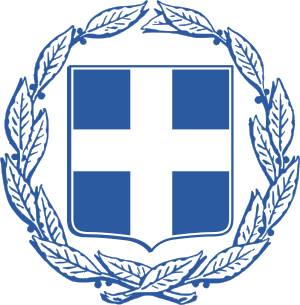
UTC+02:00Coat of Arms
What is the Flag of Greece?
The national flag of Greece is a cross-shaped white-on-blue design known as the Greek flag, or the "blue-and-white." The flag is one of the oldest national symbols in the world, having been in use since 1822. It is also one of the most recognizable flags in the world, having been adopted by the International Olympic Committee in 1896.
What Does the Greece Flag Look Like?
The Greek flag is a blue field with a white cross that extends to all four corners of the flag. The cross has a shorter vertical arm that is equal in length to the length of the horizontal arm. The shorter vertical arm is slightly thicker than the horizontal arm. In the center of the cross is a four-pointed white star. The vertical arm of the cross is slightly closer to the hoist than the horizontal arm.
What is the Greece Flag Called?
The Greek flag is often referred to as the "blue-and-white," due to the white cross against the blue background. It is also sometimes referred to as the "Hellenic Flag," due to the country's name in Greek, Hellas. Other names for the flag include the "Greek Cross" or the "Cross of Saint Andrew."
What Does the Greece Flag Represent?
The Greek flag is a symbol of Greece's struggle for independence, as well as its long and proud history. The white cross symbolizes the Greek Orthodox Church, which has been an important part of Greece's culture since the Byzantine Empire. The four-pointed star in the center of the cross represents the Virgin Mary, who is an important figure in the Greek Orthodox faith. The blue background of the flag has been used to represent freedom and democracy since the Greek War of Independence in 1821.
Who Created the Greek Flag?
The Greece flag was designed and created by the popular Greek naval officer and politician, named Epaminondas Stathopoulos. He was born in 1852 and worked in the Greek navy for many years, eventually rising to the rank of admiral in 1897. Stathopoulos was also an active politician, serving in the Greek Parliament and as a minister in various governments.
Stathopoulos is best known for designing the Greece Flag in 1822. This flag was officially adopted on December 22, 1978 when the Greek Constitution was ratified. The flag design consists of nine equal horizontal stripes of blue and white. The blue stripes represent the seas around Greece, and the white stripes represent the waves that break on the country's beaches. In the center of the flag is a white cross, which symbolizes Greek Orthodoxy, the country's official religion.
The Greek flag has a long and fascinating history. It was inspired by the flag of the revolutionary Greek War of Independence. This flag was created by the Greek revolutionary leader, Ioannis Kapodistrias, in 1822. It featured a white cross on a blue background. The white cross was meant to represent the Greek Orthodox religion, while the blue background was meant to symbolize the freedom that the revolution sought.
Stathopoulos was inspired by this flag when he designed the current Greek flag. He wanted to create a flag that would represent the Greek nation and symbolize the unity of its people. He also wanted the flag to express the country's history and culture. To achieve this, he kept the white cross in the center of the flag, but changed the blue background to the nine equal stripes of blue and white.
The design of the Greece Flag has remained unchanged since it was first adopted in 1822. It has become a symbol of the Greek nation and is widely recognized by people all over the world. It is also a reminder of the country's history and culture, and serves as a source of pride for Greeks everywhere.
Bordering Countries


Similar Flags
Flags that share colours with Greece